Cleans vary depending on your needs. Some patients require a routine scale and polish, while others may need deeper gum care. Your dentist or hygienist will explain the type of clean recommended for you.
Some health funds include orthodontic cover that may contribute towards clear aligner treatment. Our team can provide the relevant item numbers and help you check your coverage.
Most treatments are minimally invasive and performed with your comfort in mind. We use modern techniques and local anaesthesia when needed, and our team ensures you feel at ease throughout your visit.
No. Modern ceramic materials allow crowns and bridges to closely match the appearance of natural teeth, making them difficult to distinguish.
Dental X-rays use very low radiation levels. They are only taken when clinically indicated and help us detect issues such as decay, bone levels, or infections that may not be visible during a standard examination.
No. Dentures are removable and sit on the gums, while dental implants are fixed into the bone and provide a more stable solution. Implant-supported dentures combine both approaches.
Custom mouth guards are designed to fit closely to your teeth, making them more comfortable and easier to adapt to compared to generic options.
Porcelain veneers are a long-term treatment that involves reshaping a thin layer of enamel, so they’re not reversible, but they’re designed to be a lasting investment in your smile.
Composite resin can pick up mild staining from coffee, tea, or red wine over time, but this can be easily polished away during routine maintenance visits. Minor chips can also be repaired without replacing the entire restoration.
Composite veneers themselves can’t be whitened with traditional bleaching treatment, whitening gels only work on natural enamel. However, applying composite veneers can change the brightness of your smile by selecting brighter shades of composite that mask the underlying tooth structure. Professional whitening can still be applied to the natural teeth around the veneers.
Many cosmetic treatments can support long-term oral health, such as restoring worn teeth, improving bite alignment, or protecting teeth from further damage.
Absolutely. It’s often performed alongside whitening, Invisalign, or contouring to refine and complete a smile transformation.
Yes. Bonding is excellent for closing small gaps or uneven spacing between teeth, restoring balance while keeping the result natural and proportionate.
Research suggests links between gum disease and systemic health. Supporting gum health benefits whole body wellbeing.
Hybrid veneers don’t respond to whitening gels, but they can be professionally polished or resurfaced to refresh their brightness. If whitening is desired, it’s best to whiten natural teeth beforehand for a perfect match.
They’re highly resistant to stains and everyday wear. However, like any ceramic material, they can chip under excessive force. The benefit is that hybrid veneers can be repaired or repolished easily, without full replacement.
Sedation options such as IV sedation may be available for suitable patients. This can help you feel more relaxed during treatment.
No. The temporary crown must remain out of function. This means no biting or chewing on that tooth for approximately 3 to 4 months while the implant integrates. This step is critical for success.
Absolutely. General dentistry is focused on prevention. Regular visits help maintain oral health, prevent future concerns, and keep your smile feeling fresh and comfortable.
Yes, and we would encourage it for any significant decision. Bring your partner, a family member or a friend. People retain surprisingly little of a consultation, particularly an anxious one, so a second set of ears is genuinely valuable, and the person you would have discussed it with afterwards has already heard everything first-hand.
Yes, in most cases. Your clinician will advise if different care is needed.
Yes. Simply remove your aligners before meals and enjoy your food as usual. Avoid hot beverages while wearing them, as heat can distort the material.
Yes. Simply remove your aligners before meals and enjoy your food as usual. Avoid hot drinks while wearing aligners, as heat can distort them.
Yes. Once healed, implants function like natural teeth, allowing normal eating and speaking.
Soft foods and gentle care are recommended initially. Guidance is provided based on your procedure.
You may need to adjust your diet initially, starting with softer foods. Over time, most patients adapt and expand their food choices.
Absolutely. Hybrid veneers are designed for everyday function. You can enjoy your favourite foods comfortably. We just recommend avoiding biting directly into very hard items like ice or shells, just as you would with natural teeth.
Yes. We offer same-day emergency dentist appointments at our clinics and aim to see urgent cases as quickly as possible. Call us directly on 07 3821 0277 for our Cleveland clinic and our team will work with you to find the earliest available time.
Yes. A natural-looking temporary restoration is provided so you never have to go without a tooth during the healing phase.
Yes. One of the main advantages of composite veneers is that your new smile can be crafted and completed in a single appointment, without the need for temporary veneers or multiple visits.
Absolutely. Many patients transition from dentures to fixed bridges for greater comfort, stability, and aesthetics.
We can evaluate your bone and gum health to determine the best plan for your upgrade.
Over-the-counter guards are available, but they are often bulkier and less precise, and don’t last as long. Custom mouth guards provide a better fit, improved comfort, and more effective protection.
Porcelain doesn’t respond to whitening gels, but professional cleaning and polishing can keep them radiant.
Yes. Implants can support crowns or bridges that replace multiple teeth.
Yes. Strategic placement allows several teeth to be supported efficiently while maintaining stability and aesthetics.
Porcelain is highly resistant to stains, unlike natural enamel or composite resin. Coffee, tea, and wine won’t dull their brightness, though regular polishing helps maintain their pristine finish.
Cleans improve brightness by removing surface staining. Whitening options are also available if desired.
Absolutely. When crafted well, composite veneers can look incredibly natural. The artistry lies in the layering, shaping, and polishing, capturing the same light and translucency as real enamel.
Yes. We assess growth and alignment and provide guidance or referrals as needed.
No. If wisdom teeth are healthy, fully erupted, and easy to maintain, removal may not be necessary. Treatment is only recommended when there is a clear clinical reason.
You may feel light pressure when switching to a new set, a sign that your teeth are shifting as intended. Any discomfort is typically mild and short-lived, making the process far gentler than braces.
There may be a short adjustment period as your tongue adapts. Speech usually improves with time and practice.
Traditional dentures rely on the shape of the gums and suction for retention. Some movement is normal, particularly in the lower jaw. Implant-supported options can improve stability.
Yes. Hybrid ceramics have beautiful translucency and depth, closely mimicking natural enamel. While full porcelain still offers the ultimate optical refinement, hybrid veneers provide an incredibly natural, harmonious result that blends seamlessly with your smile.
No, preparation done on the teeth depends on the current position of your teeth and whether any camouflage is being conducted to change the positions of the underlying teeth. In an ideal tooth setup, it is very little. Modern veneer techniques are minimally invasive, often removing less than 0.3–0.5 mm of enamel (about the thickness of a contact lens). This gentle contouring ensures your veneers sit seamlessly and naturally on the teeth, without appearing bulky or artificial.
In most cases, yes. Within 24–48 hours, a fixed temporary bridge is fitted to your implants.
This lets you leave with a complete, natural-looking smile while your final ceramic bridge is being planned and fabricated.
Almost never. Most plans can be sequenced by clinical priority, so anything urgent is cared for first and elective treatment follows when it suits you. We will always tell you which is which, and specifically what can safely wait. That distinction is often the difference between a plan someone begins and a plan someone quietly avoids.
In many cases, yes. A crown helps protect the tooth from fracture and restores strength, particularly for back teeth.
No. We take on clinicians at different stages and mentor them towards more advanced work. What we do look for is genuine appetite, because mentoring only rewards someone who wants to be stretched. If you already have advanced experience, you will find the equipment, the case mix and the autonomy here suit you well.
Not always. Strategic placement can support several teeth with fewer implants.
Yes. After treatment, you’ll wear a discreet retainer (usually at night) to maintain your results and ensure your smile stays perfectly aligned long-term.
Absolutely not. That’s a common misconception. At Altura, our approach is preservation-focused. We keep your natural teeth almost entirely intact. Only the minimum amount of enamel is reshaped to allow integration with your porcelain veneers. Your teeth remain strong, healthy, and very much your own.
Yes. Retainers are essential to maintain your results. They prevent teeth from shifting back and are usually worn at night for long-term stability.
Only when clinically appropriate. Your clinician will explain why and when they are recommended.
If signs of grinding or clenching are present, a night guard can help protect your teeth from ongoing wear and reduce strain on your jaw.
Absolutely. While an implant can’t decay, the surrounding gum and bone still require care.
Daily brushing, flossing, and regular hygiene visits are essential, the same as for natural teeth.
Just like with a car or a natural smile, consistent maintenance is what keeps everything performing beautifully for the long term.
Yes. Even though your new teeth are fixed, oral hygiene remains essential.
Just like natural teeth, All-on-4 bridges require daily cleaning and regular check-ups to prevent gum inflammation or infection around the implants.
There’s no difference in hygiene commitment between maintaining natural teeth and maintaining implants. Both require care and consistency.
Absolutely. Whether your smile is transformed through veneers, bonding, or full rehabilitation, oral hygiene remains essential. Restorative or cosmetic treatments don’t replace the need for daily care; they simply give you a stronger, more beautiful foundation to maintain.
Even patients who choose All-on-4 implants still need to brush, clean, and maintain their restorations carefully. The difference is simply what you’re looking after: natural teeth or implant restorations, but the commitment to hygiene is the same.
Regular brushing, flossing (or interdental cleaning), and professional check-ups keep your gums healthy and your results long-lasting. Think of your new smile as a precision-engineered investment. It looks and performs beautifully when cared for properly.
Yes. When crafted with precision, porcelain veneers can look indistinguishable from natural teeth. At Altura, every design considers your facial proportions, skin tone, and the way light interacts with your smile, ensuring lifelike, seamless results.
Sedation options are available and discussed during consultation.
Yes. Many families schedule together for convenience.
Yes, for the right person. A new graduate who is curious, coachable and warm with patients is a better fit for us than an experienced clinician who is settled in their habits and difficult to work alongside. If you have recently graduated, apply and be candid about what you do not yet know. Nobody expects otherwise, and pretending is a far greater concern than inexperience.
Not as a rule. The investment is ours, and it is not passed on to you as a separate charge. In several areas it works in your favour, since designing and producing in house removes external laboratory and courier costs from certain treatments, and fewer appointments means less time away from your day. Where a treatment does cost more, it reflects the materials and the craftsmanship involved, and you will have that in writing before you decide anything.
Care is taken to ensure comfort. Any post treatment tenderness typically settles with gentle support and recommended care.
Often the overall timeline is shorter, because production and delivery delays come out of it. What in-house work cannot shorten is biology. Bone healing and integration take the time they take, and we would rather be patient than compromise your result. We will happily remove delays that are logistical, and never the ones that are clinical.
Most patients describe only mild pressure when switching to a new set of aligners, a sign your teeth are gently shifting. It’s far more comfortable than traditional braces.
Routine exams often include a clean unless a separate visit is needed for more detailed care.
We focus on comfort and may use anaesthetic when appropriate.
Clear aligners straighten your teeth discreetly without metal brackets or wires. They’re removable, easier to clean, and far more comfortable, offering the same great results with greater flexibility and aesthetics.
Clear aligners use a series of custom-made, removable trays that apply gentle, consistent pressure to move your teeth step by step into ideal alignment.
The functionality of both the porcelain and composite veneers is the same. What differs is the material used. Porcelain veneers are crafted in a dental lab and bonded later, while composite veneers are sculpted directly onto your teeth in one visit. Composite offers a more accessible, flexible solution, whereas porcelain provides greater durability and stain resistance.
Porcelain veneers are entirely ceramic and offer unmatched long-term durability and optical beauty. Hybrid veneers, while slightly softer, provide similar aesthetics, quicker turnaround times, and easier maintenance, making them ideal for patients who want the best of both worlds.
Care is similar to natural teeth. Brushing, flossing, and regular dental visits are essential to maintain the health of both the restoration and surrounding teeth.
Dentures should be removed daily for cleaning. Brushing, soaking, and maintaining good oral hygiene are essential to keep both the denture and your gums healthy.
Rinse after use, brush gently, and store it in a ventilated case. Regular cleaning helps maintain hygiene and prolong its lifespan.
Every smile is unique. We begin with a thorough consultation, photos, scans, and examinations to recommend treatments that align with your goals, comfort, and long-term dental health.
Begin with a free consultation. We’ll discuss your goals, show you what’s possible, and outline a tailored plan. There’s no obligation, just clarity and guidance for your smile journey.
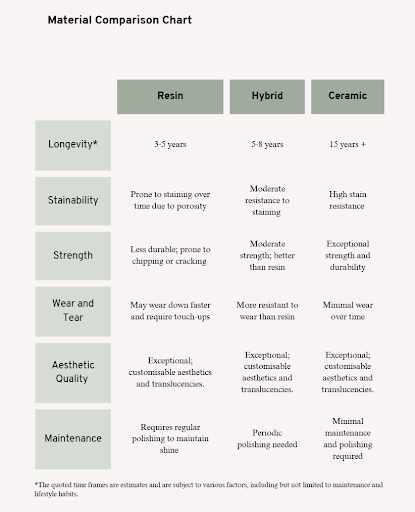
Composite veneers are hand-layered directly on the teeth, while hybrid veneers are milled from a solid ceramic block, offering greater strength, precision, and stain resistance. They bridge the gap: more durable than composite, more cost-effective than porcelain.
We use gentle communication, time, and reassurance to build trust. Parents are welcome to stay close.
Invisalign utilises a set of clear plastic ‘trays’ or aligners that are made custom to your teeth. These series of trays are design to gently and slowly move your teeth over a period of time. Compared to traditional braces, Invisalign is barely noticeable. With traditional braces you will be able to see the metal brackets and wires in the mouth however with Invisalign the aligners are clear, and as such very hard to notice. Hygiene is also greater improved as Invisalign is able to be removed from the mouth when cleaning.
Invisalign uses a sequence of clear, removable aligners that gently move your teeth in small, planned increments. Each aligner builds upon the last until your smile reaches its ideal alignment.
Unlike removable dentures, All-on-4 bridges are fixed via prosthetic screws to implants.
They feel stable and secure, don’t shift when you speak or eat, and allow you to bite and chew with confidence.
While both treatments use composite resin, the difference lies in coverage and purpose:
| Bonding/ Edge Bonding | Composite Veneers |
|
|
Think of composite veneers a little like a luxury car. Their longevity depends on how well they’re cared for. With good habits and regular maintenance, they can last beautifully for many years. Studies show around 90% of composite veneers remain in excellent condition after five years, and many last much longer.
Their true advantage is versatility. If a veneer ever chips, wears, or loses a little lustre, it can be easily repaired or refreshed without needing to replace the entire smile. With the right care, your veneers can continue to look and feel as stunning as the day they were placed.
With proper care and maintenance, results can last many years. We use durable, high-quality materials and provide personalised care plans to support the longevity of your smile.
With appropriate care, crowns and bridges can last many years, often more than ten. Longevity depends on oral hygiene, bite forces, and regular maintenance.
Dentures typically last several years, but they may need adjustments, relining, or replacement over time as the shape of the gums changes.
With proper care, 90% of hybrid veneers typically last 5-10 years. Their lifespan depends on individual maintenance and habits, just like looking after a finely tuned car. Regular check-ups, gentle care, and avoiding habits like biting hard objects will keep them performing beautifully.
Porcelain veneers are incredibly durable. Research shows over 90% remain in excellent condition after 10 years, and many last well beyond 15 years with good care. Regular check-ups, a nightguard (if you grind your teeth), and gentle maintenance help preserve their longevity.
Dental implants are designed for long term success, supported by regular maintenance and care.
This depends on usage and grinding intensity. With proper care, a custom mouth guard can last several years, although it may need replacement if wear occurs.
With appropriate restoration and ongoing care, a root canal treated tooth can last many years. Longevity depends on factors such as tooth structure, bite forces, and oral hygiene.
Treatment is usually completed over one or two appointments, depending on the complexity of the tooth and level of infection.
Like any precision restoration, it depends on how well it’s cared for, much like how long a car lasts depends on its maintenance. The implant itself can potentially last more than 10 years with excellent hygiene, regular reviews, and professional care.
That depends on your treatment plan. Some cosmetic makeovers can be completed in 2–3 visits, while full rehabilitations may take a few months.
We’ll tailor the process to your lifestyle and priorities.
With good care, edge bonding typically lasts around 5 years before needing maintenance or touch-ups. Longevity depends on factors like grinding habits, diet, and oral hygiene, but touch-ups are quick and straightforward when needed.
Implants typically integrate over several months before final crowns are placed.
Bone growth takes time. Most cases require several months before implants can be placed.
You can expect some mild tenderness for a few days after surgery, but most patients return to normal activities within a week.
We prescribe plenty of medication so that post-operative symptoms will be well controlled.
The implants fully integrate over 4–6 months, during which your temporary bridge supports both healing and confidence.
Most patients recover within a few days, although full healing of the area may take a few weeks. Recovery time depends on the complexity of the extraction.
From implant placement to final crown, treatment usually takes 3–6 months, depending on healing. The planning and design phases ensure a precise, long-lasting result.
Most Invisalign treatments take 6–18 months, depending on your starting point and goals. We can estimate your timeframe precisely during your digital scan and design consultation.
Treatment time varies depending on your starting position and goals but typically ranges between 6–18 months. We’ll estimate your timeline during your consultation and digital scan.
Recovery time varies. Your clinician will provide specific advice and follow up support.
It depends on how well it’s cared for, much like how long a car lasts depends on its maintenance.
The implants themselves are designed to be a long-term foundation, and with excellent hygiene, regular reviews, and professional care, they can last for a long time.
The bridge (the teeth that attach to the implants) will experience normal wear over time and may need periodic servicing, repairs, or eventual replacement, just as a car needs servicing to stay at its best.
The key is consistency. Daily cleaning, routine check-ups, and maintenance visits are what keep your investment performing beautifully for the long term.
With proper care and maintenance, a full smile transformation can last 10 years or more depending on the type of material and stages of treatment completed.
We design every case with long-term stability and ease of maintenance in mind.
Most patients recover quickly after a filling. Extractions require a short healing period which we support with clear guidance.
Costs vary depending on the treatment and your individual plan. We provide clear, obligation-free information on fees, timelines, and options so you can make an informed decision.
Preparation done on the teeth depends on the current position of your teeth and whether any camouflage is being conducted to change the positions of the underlying teeth. In an ideal tooth setup, it is very little. Modern veneer techniques are minimally invasive, often removing less than 0.3–0.5 mm of enamel (about the thickness of a contact lens). This gentle contouring ensures your veneers sit seamlessly and naturally on the teeth, without appearing bulky or artificial.
Costs vary depending on the type and complexity of care required. You’ll receive clear information before any treatment begins, including options and expected fees, so you can make an informed decision with confidence.
For best results, wear your aligners 22 hours per day, removing them only to eat, drink, or brush. Consistency ensures your teeth move according to plan.
Most people benefit from seeing their dentist every six months, though some may require more tailored intervals depending on gum health, restorations, and individual risk factors. Your dentist will recommend a schedule that suits your needs.
Most patients benefit from visits every six months. Some may require more frequent support.
Most people benefit from visits every six months. Your dentist will tailor timing based on your needs.
For the best results, aligners should be worn for 20–22 hours per day, removing them only to eat, drink (other than water), or brush. Consistent wear ensures your teeth move predictably according to plan.
As part of the consultation and examination we will take a 3D X-ray scan to visualise the bone available. If there is insufficient bone we generally conduct a procedure known as bone regeneration to regenerate the missing bone, sometimes this is done simultaneously with the implant placement.
Absolutely. Many of our patients arrive believing their only option is extraction, only to discover that full rehabilitation can restore both strength and beauty.
With digital design, we can show you what’s possible before treatment begins, helping you see the transformation that feels impossible right now.
More than most people expect. Scanning removes impression trays, contemporary instrumentation shortens the longest appointments, and careful planning means fewer unknowns for you and for us. There is a screen above every chair if distraction helps. Most of all, seeing your own images explained gently tends to settle nerves more effectively than reassurance alone, because so much dental anxiety is really the discomfort of not knowing. Tell us when you book, and we will shape the appointment around it.
It is close to the reason this practice exists, so no. Mention it when you book and your appointment changes shape: more time, a gentle first visit that may involve no treatment at all, everything explained before it happens, an agreed signal to pause at any moment, and distraction if that helps you. Many of the patients we now see regularly first came to us feeling exactly this way.
No, and this is the single most common worry we hear. Long gaps are entirely normal and there is almost always a reason behind them, whether that is a difficult experience, cost, or simply life getting in the way. Our role is to tell you where things stand today and what your options are from here, not to comment on how you arrived. You will be met with warmth, and nothing else.
While it is correct that in some occasions root canal therapy doesn’t work, this is extremely rare if the procedure is carried out with the correct equipment techniques. Dental literature shows an extremely high success rate above 90% over 8 years when it has been protected with a crown.
Cone beam imaging uses considerably less radiation than a conventional medical CT scan of the same area, and modern digital X-rays less again. Even so, no image is taken casually. We take a 3D scan when the additional detail will genuinely inform your treatment, such as planning implants or assessing anatomy a flat X-ray cannot show. Where it is not clinically justified for you, we will not take one.
This depends on the condition of the surrounding teeth and your overall treatment goals. Implants do not rely on neighbouring teeth, whereas bridges do. We will guide you through the most suitable option.
For most restorative work, yes, and importantly it stays accurate. Impression materials can distort as they set or in transit, while a digital record does not shrink, warp or come to harm in the post. Traditional impressions still suit certain situations, and where one is genuinely the better choice for your treatment we will use it and explain why.
Yes. Brushing and flossing help maintain daily hygiene, but a professional clean removes plaque and tartar that can’t be removed at home. It also allows us to monitor areas that may need attention before they become concerns.
Depending on the adjacent teeth but generally Yes, A bridge requires reshaping the healthy teeth beside the gap, whereas an implant stands independently, protecting your natural enamel and helping preserve the jawbone beneath.
Not at all. Altura is a general dental practice that also offers advanced cosmetic and implant care. Check-ups, cleans, fillings, children and emergencies are central to what we do, and most of our patients are here for exactly that. The advanced capability simply means that if something more complex ever arises, you are already among people who know you.
Not at all. Depending on the underlying tooth structure, it may not require anaesthetic or drilling.
Not always. It depends on your bone levels. Your clinician will assess and explain your options clearly.
Not always. It depends on bone levels. Your clinician will assess and guide you on your options.
No. Suitability depends on bone quality, gum health, infection control, and bite forces. We only recommend this option when conditions are ideal for predictable long term success.
Early stages can often be reversed. More advanced cases can be managed effectively with consistent care.
In many situations, preserving the natural tooth is preferable when possible. Root canal therapy allows the tooth to remain in place and function normally.
The procedure is performed under local anaesthetic or sedation, so you won’t feel any discomfort during treatment.
Afterwards, mild soreness is easily managed with prescribed medication.
Root canal therapy is performed under local anaesthetic, so you should not feel pain during the procedure. Most patients describe the experience as similar to having a filling.
It is real, and the most reliable evidence is that our team raises it unprompted when asked what makes this place different. Funded courses apply across the practice, not only to dentists. In your interview, ask specifically what the last three team members were sent on. We would far rather answer that than have you take our word for it.
Yes. Once healing is complete and the final crown is placed, the long term outcome is exactly the same if not better, provided the implant has been protected from loading during the healing phase.
No. Implant placement is done under local anaesthetic or sedation for complete comfort. Most patients describe only mild tenderness afterward, easily managed with over-the-counter medication.
Not at all. The process is gentle and comfortable, performed under local anaesthetic if needed. Most patients describe the experience as smooth and surprisingly easy.
No. The process is gentle and comfortable. In some cases, there’s no need for anaesthetic at all.
Treatment is performed under local anaesthetic, so you should not feel pain during the procedure. Mild sensitivity afterward is possible but typically short-lived.
Care is taken to make the experience comfortable. Healing is supported with attentive follow up.
Often, depending on the role and what the practice needs at the time. Tell us what you are looking for in your application rather than assuming the answer is no. We would much rather find a way to work with someone excellent than lose them over scheduling.
Yes. In many cases, we can save and rebuild your natural teeth, even when they appear severely damaged or worn.
All-on-4 is a great solution when teeth are beyond saving, but we often find that patients have far more healthy structure remaining than they think. Our goal is to preserve what nature gave you, not replace it unnecessarily.
When performed by a highly trained clinician and in the right case, immediate implants are very successful and in fact the same success rate as a standard implant.
The key factor is experience and precision.
Yes. Preventative care builds healthy habits for all ages.
The procedure itself is performed under anaesthetic, so you should not feel pain during treatment. Some discomfort is expected during recovery, but this is usually well managed with medication.
Yes. We keep expressions of interest open permanently, and several of our current team joined us that way. Practices grow unevenly, and the right person often arrives before the vacancy does. If this page describes how you already work, tell us, and we will keep you properly in mind.
Hybrid veneers are made from an advanced hybrid ceramic, approximately 70% porcelain and 30% resin. This combination blends the strength and gloss of porcelain with the resilience and repairability of composite
Porcelain veneers offer a smile transformation in both colour, size, shape, to achieve ideal smile parameters, something whitening or bonding alone can’t always achieve.
While whitening simply brightens your existing teeth and bonding repairs isolated areas (mainly the bottom 30-40% of your tooth), porcelain veneers redefine proportion, symmetry, and overall harmony, creating a smile that looks naturally flawless and stays radiant for years.
Gum bleeding can be a sign of inflammation, often caused by plaque buildup. It’s best to have this assessed during a check-up so we can determine the cause and provide guidance to improve gum health.
You can enjoy nearly all the same foods you always have. Porcelain veneers are incredibly strong once bonded and can handle normal eating comfortably.
We simply recommend treating them as you would natural teeth. Avoid using them to bite hard objects like ice, nuts in their shell, or opening packages. With mindful care, you can eat, smile, and live freely without restrictions.
A check-up involves assessing your teeth, gums, bite, and soft tissues, along with reviewing any changes since your last visit. Digital imaging may be taken if needed. We explain each step clearly so you always understand what’s being done and why.
Delaying treatment may allow the infection to progress, potentially leading to increased pain, swelling, or the need for more complex treatment.
In most cases, you would need to wait several months before implant placement and wear a removable temporary appliance during healing, which many patients find uncomfortable and inconvenient.
Untreated wisdom teeth can lead to infection, decay, gum disease, or damage to adjacent teeth. Early assessment helps prevent more complex issues.
If you misplace an aligner, contact us right away. We’ll advise whether to move to your next set or replace the missing one to keep your progress on track.
We welcome you to share your concerns. Our approach supports anxious patients with patience and reassurance.
Please tell us early. It genuinely improves the conversation rather than complicating it. Most treatment can be staged over time so that what matters clinically happens first, payment plan options are available, and in some circumstances early release of superannuation is a pathway we can explain. What we will not do is present one expensive option as though it were the only one.
You are welcome to share how you feel. We support anxious patients with extra care and gentle pacing.
It’s completely normal to feel anxious. Our clinics are designed to feel calm and unhurried, and we take time to explain each step before we begin. You’re welcome to pause at any time, and options for additional comfort can be discussed if needed.
If an aligner is misplaced, contact us right away. We’ll guide you on whether to move to your next set or have a replacement made to keep your progress on track.
If you’re considering whitening, it’s always best to whiten before bonding. Composite resin doesn’t change colour with whitening treatments, so we want your natural teeth to reach their ideal brightness first.
After whitening, we recommend waiting two weeks before applying bonding. This allows the enamel to stabilise and ensures optimal bonding strength and shade matching. During this period, it’s important to avoid any further whitening, so your teeth maintain a consistent, final colour for perfect integration.
Call us and describe what you’re experiencing. Our team can help you decide whether you need to come in today or whether your concern can be managed at a scheduled appointment. We would always prefer you reach out and be reassured than wait and have things worsen.
We tailor treatment to your comfort and provide options to soothe sensitivity.
Four implants support a full arch of fixed teeth, often avoiding extensive grafting and providing immediate provisional teeth.
Cosmetic dentistry focuses on enhancing the appearance of your teeth, gums, and smile while maintaining your oral health. Treatments can improve colour, shape, alignment, and overall harmony, tailored to your personal goals.
A crown covers and protects a single tooth, while a bridge replaces one or more missing teeth by connecting to adjacent teeth or implants.
Usually an informal conversation first, so both of us can sense whether the values fit before anyone invests serious time. From there, a more structured interview and, for most roles, a paid working day in the practice. That day matters in both directions: you meet the team you would actually work with, on an ordinary day rather than a staged one.
Care for them as you would your natural teeth: daily brushing, flossing, and regular dental visits. Avoid biting hard objects (like pens or ice), and consider periodic professional polishing to maintain their shine.
A fair question, since warmth is easy to claim. Look instead at the commitments that cost us something: no decision on the day, no deposit at a consultation, costs in writing before treatment, and a genuine willingness to recommend less. Those are the ones that are inconvenient to keep, which is what makes them meaningful.
If a tooth has been knocked out, time matters. Keep the tooth moist ideally by placing it back in the socket, or in a small container of milk and call us immediately. In some cases, a knocked-out tooth can be reimplanted if treated quickly enough.
Depending on your goals and oral condition, your transformation may include:
A cosmetic transformation focuses on enhancing the visual appearance, shape, colour, and alignment, through treatments like veneers or bonding.
A functional transformation (rehabilitation) restores the bite and structure of worn or damaged teeth, improving both function and aesthetics. Most full smile makeovers include elements of both.
All-on-4″ refers to using four implants per arch, while “All-on-X” simply means more than four (often five or six) are used for additional support, depending on bone structure and treatment needs.
They’re essentially the same. Edge bonding is just a more specific term describing where the bonding is placed, usually on the lower portion or edges of the teeth (around 30–40% of the surface). You may hear the terms bonding and edge bonding being used interchangeably.
Both porcelain and composite veneers can beautifully transform a smile. The difference lies in material, craftsmanship, and longevity.
Composite veneers are sculpted directly onto your teeth in a single visit and are ideal for subtle, accessible improvements. Porcelain veneers, on the other hand, are individually crafted by master ceramists, offering superior durability, lifelike translucency, and stain resistance. They’re the more refined, long-term option, a true investment in lasting beauty.
Porcelain veneers cover only the front surface of the tooth, preserving as much natural structure as possible, it’s more like a thin shell that sits on the surface, much like a contact lens for your tooth, subtle, precise, and transformative. Crowns, by contrast, encase the entire tooth and are used when teeth are heavily worn, cracked, or previously restored much like a helmet.
If your teeth are healthy and strong, veneers are a more conservative and aesthetic option, offering beautiful results with minimal alteration.
A filling is recommended when decay or damage affects the structure of a tooth. Treating it early helps prevent discomfort and preserves the remaining healthy tooth structure. We’ll always discuss findings with you before recommending treatment.
In some cases, earlier removal can be beneficial as healing may be more predictable. However, timing depends on symptoms, positioning, and overall oral health.
Around twelve months of age or when the first tooth appears.
We serve Brisbane from two sites in Bowen Hills and Cleveland. Both offer cosmetic, implant, and general care. When you book, our team suggests the location and time that best suits your schedule. If your plan involves several visits we aim to keep those visits at the same site for convenience.
Shop 2, 111 Queen Street, Cleveland, in the Redlands on Brisbane’s bayside. It is a gentler daily commute than most inner-city practices, and many of our team live locally. If you are travelling from further afield, raise it early and we will be straight with you about whether the roster makes it workable.
This treatment is ideal for patients who are missing all or most of their teeth, or whose remaining teeth are failing and cannot support traditional restorations.
If you’ve been told you need dentures, All-on-4 may be a life-changing fixed alternative.
Because an implant is intended to serve you for decades, and two things matter over that horizon: the evidence behind the surface, and the confidence that components will still be available many years from now. Neodent sits within the Straumann Group, among the most thoroughly researched implant groups in the world, and the Acqua surface is designed to support integration during early healing. Less expensive systems exist, and the saving is real, but so is the compromise.
The pricing of our standard single implants is based on a healed ridge (already missing tooth) with sufficient bone volume.
This treatment combines several procedures into one highly technical appointment. The cost includes the extraction of the existing tooth, bone substitutes or grafting if needed, implant placement, and a custom provisional crown. Without this approach, patients often still need to pay for a removable temporary tooth, extractions and bone substitutes regardless, which adds cost and inconvenience.
A mouth guard does not stop the habit itself, but it protects your teeth from the effects of grinding and helps reduce damage over time.
No. Bonding is additive, meaning the resin is applied over your existing enamel without removing or damaging it. It’s one of the most conservative cosmetic options available.
Dentures can take time to adjust to. With proper fit and gradual adaptation, most patients become comfortable with speaking and eating.
You do not feel the material itself. You simply allow the area to heal while we guide your progress.
You will not be asked to decide on the day. We give you a written plan to take home, take no deposit at a consultation, and never use offers that expire to hurry a decision. If we follow up, it is to answer your questions. You are also very welcome to seek a second opinion, and if that helps you feel confident, we would encourage it.
Local anaesthetic and gentle care help ensure comfort. Some tenderness after the oral surgery is normal and temporary.
Yes, depending on your overall treatment plan we can provide provisional teeth to wear right after the ‘preparation phase’ of your smile transformation. These provisional teeth are meant to act as a blueprint for your final teeth and will provide an instant change.
Yes. Maintenance is key to long term gum health.
You will see a considered digital proposal of the planned result, shaped around your face and your bite, and you are welcome to discuss and refine it before treatment begins. We are careful not to overstate this. A digital design is a plan rather than a photograph of the future, and your own anatomy and preferences will shape the final outcome. For cosmetic treatment we go further, with a refinement stage where you live with provisional teeth and request changes that are then copied into your final restorations.
Yes. With precise planning and high-quality ceramic restorations, your implant looks, feels, and functions like a natural tooth.
Yes. Each crown is digitally designed and hand-finished to match the colour, translucency, and shape of your natural teeth. It will blend seamlessly into your smile.
Always. Our goal is to design a smile that complements your facial features, not overpower them.
Each restoration is crafted with natural proportions, translucency, and texture for a refined, believable result.
Yes. Every All-on-4 case is designed with your facial structure in mind. The shape, shade, and contours are customised to complement your features for a lifelike, confident smile.
Yes. Our approach is to enhance your natural features rather than create a generic “perfect” smile. Every detail, from shape and colour to proportions, is carefully planned to complement your face and personality.
Hardly. Invisalign aligners are clear and fit snugly against your teeth, making them almost invisible in everyday life even in photos.
Hardly. Clear aligners are virtually invisible. They sit snugly over your teeth and are almost undetectable in conversation or photographs.
Some private health funds will cover part of the Invisalign treatment costs. Our reception team can provide you with Invisalign treatment numbers and check if you’re covered.
We take care to ensure comfort. You may feel gentle pressure rather than pain.
Yes. It is designed to look natural and support the gums, but it is intentionally not designed for chewing.
Patient comfort is something we take seriously, even in urgent situations. We use topical anaesthetic before any injections to ensure the area is fully numb before treatment begins. If you are anxious about your appointment, please let us know, we can talk through options to help you feel at ease.
Yes. Porcelain, composite, and hybrid options are available. Each suits different goals and budgets. Your dentist assesses enamel, bite, and desired changes before recommending a path. Tooth preparation is kept conservative. Shade and surface texture are planned so the result looks natural and is straightforward to maintain.
Not always. An implant can be a dependable option. Some patients suit a bridge or another restorative plan. We explain pros and cons in plain language and outline timelines, maintenance, and costs. You can then make an informed choice that matches your priorities. Suitability is confirmed at a consultation.
Yes. Your comfort matters a great deal to us. We take time to explain each step and offer small comforts that reduce stress. Options such as happy gas or IV sedation may be discussed when appropriate. Your coordinator remains a single point of contact so you always know who to call with questions.
Before treatment you receive itemised costs and a proposed sequence of visits. Staged plans are available for many cases. Our team can discuss payment options and health fund claims where relevant. We avoid confusing offers and keep all fees clear from the start.
Longevity depends on the treatment, your bite, and daily care. We design maintenance plans with routine reviews and professional cleaning. Night guards are advised for heavy grinders. Your dentist will discuss expected care so you know how to protect your result over time. Individual outcomes vary and consultation is required.
